SDVOSB · VETERAN-LED
Home/Industries/Healthcare & Hospitals
// Case Study · Healthcare & Hospitals

Code alerts that reach the right team, instantly.

A regional health system replaced overhead-only paging with role-based, HIPAA-aware alerting — code blues, infant and patient security and severe-weather lockdowns routed to exactly the right staff on every device.

ClientRegional health system
RegionU.S. Southeast
Deployment7 months
Scale4 hospitals · 6,400 staff
Deployment SnapshotOPERATIONAL
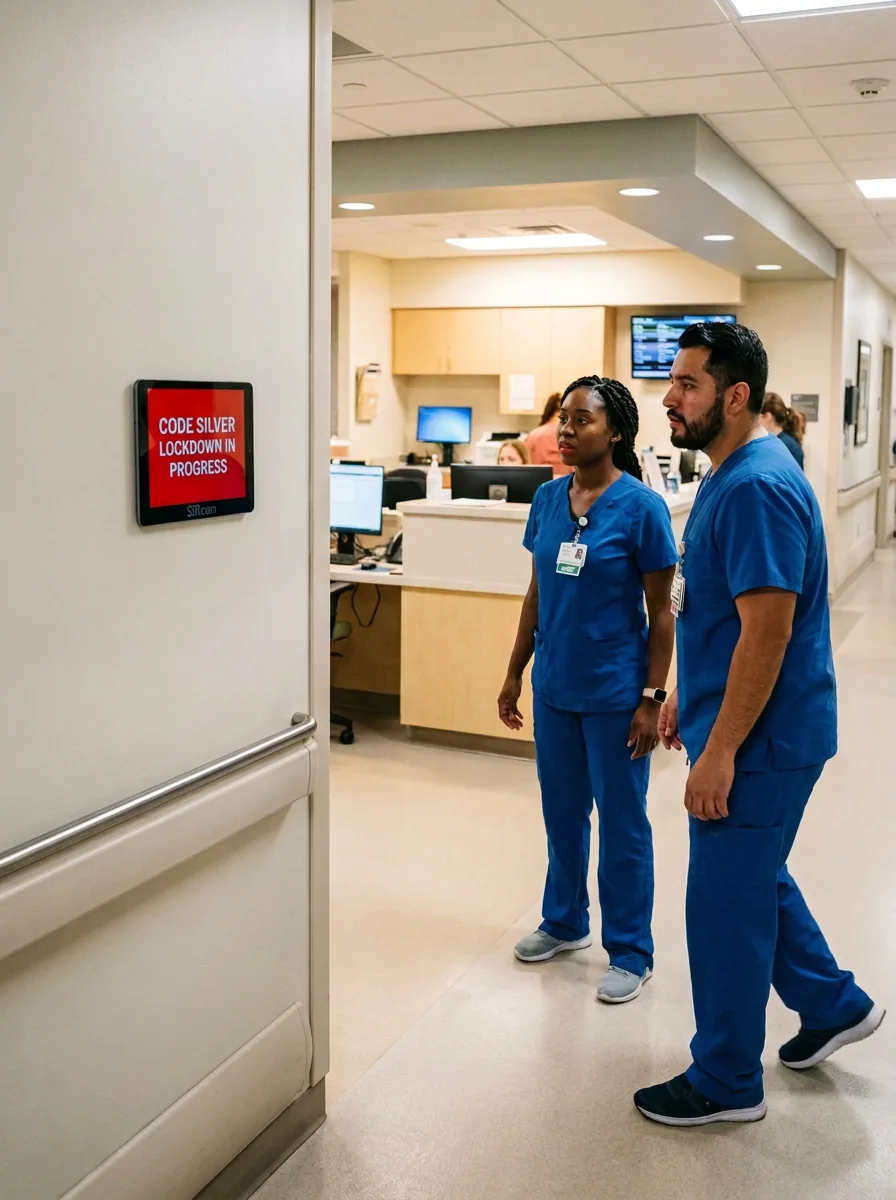
Two nurses in a hospital corridor reading a wall-mounted alert display showing CODE SILVER LOCKDOWN IN PROGRESS
Code teamRole-based routingESCALATING
Patient & visitor securityRTLS + door holdSECURED
Mass notifyStaff + publicREADY
4
Hospitals
6,400
Staff reached
38%
Faster code response
24/7
Monitored
The operational reality

Overhead paging woke the whole building — and the wrong people

Every code went out over overhead paging: the right responders heard it, but so did everyone else, all day. The result was real alert fatigue and slower response when it counted.

Infant and high-value asset elopement risk wasn't tied to door control, there was no clean severe-weather lockdown workflow, and Joint Commission emergency-readiness documentation was a manual scramble.

Wrong-audience pagingOverhead-only alerts hit everyone, driving alert fatigue and slow response.
Elopement riskInfant / asset security wasn't integrated with door control.
No lockdown workflowSevere-weather and active-threat lockdowns were ad hoc.
Accreditation burdenJoint Commission readiness evidence was assembled by hand.
The HQE solution

A unified system, engineered to fit

HQE made every alert role-aware — routed to the team that can act, logged for the surveyors, and tied to the doors.

1
Route

Role- & unit-based alerting

Codes now escalate to the specific care team and unit on their own devices, with automatic escalation if unacknowledged.

2
Secure

Infant / asset RTLS

Real-time location tags integrate with access control to hold doors and trigger a security response on elopement.

3
Lockdown

Weather & threat templates

Pre-built severe-weather and active-threat workflows drive notification, signage and door control together.

4
Document

Accreditation-ready logging

Every activation is time-stamped and exportable as Joint Commission-ready audit evidence.

Systems deployed

The stack behind it

Every deployment is brand-agnostic and built from HQE's proprietary, ML/AI-powered ecosystem — integrated into one pane of glass.

SiSA Alert Software Electronic Security RTLS infant security Access control Mass notification
How we deliver

From survey to sustained operations

A disciplined, mission-grade delivery process — the same five phases on every HQE engagement.

01

Assess

RF / coverage survey, threat model & compliance gap analysis on-site.

02

Design

Brand-agnostic system design engineered to your facilities & mandates.

03

Integrate

Bridge existing systems — alarms, access, C2 — into one pane of glass.

04

Deploy

Phased install, load-testing, live drills & operator certification.

05

Sustain

24/7 monitoring, supervised health & lifecycle support contract.

The outcome

Measurable mission impact

38%

Faster code response

Role-routed alerts reach the team that can act, not the whole campus.

0

Elopement incidents

No infant or protected-patient elopement events since go-live.

100%

Audit trail

Complete, exportable activation logs for accreditation surveys.

“
Codes now go to the team that can act, not the whole building. The alert fatigue is gone.
VPVP of Safety & SecurityRegional health system
Explore more

Related industries

Built for healthcare & hospitals

Let's design your healthcare & hospitals solution

Tell us your operational pain-points. Our veteran-led team will engineer a future-proof, fully-integrated life-safety & security solution around them.